Freddie Mercury: lead vocals, backing vocals, piano
Brian May: acoustic guitar
John Deacon: bass
Roger Taylor: drums
Recorded
Mountain Studios, Montreux: mid-July–August 1978
Super Bear Studios, Berre-les-Alpes: September–October 1978
Technical Team
Producers: Queen, Roy Thomas Baker
Sound Engineer: Geoff Workman
Assistant Sound Engineer: John Etchells
Single
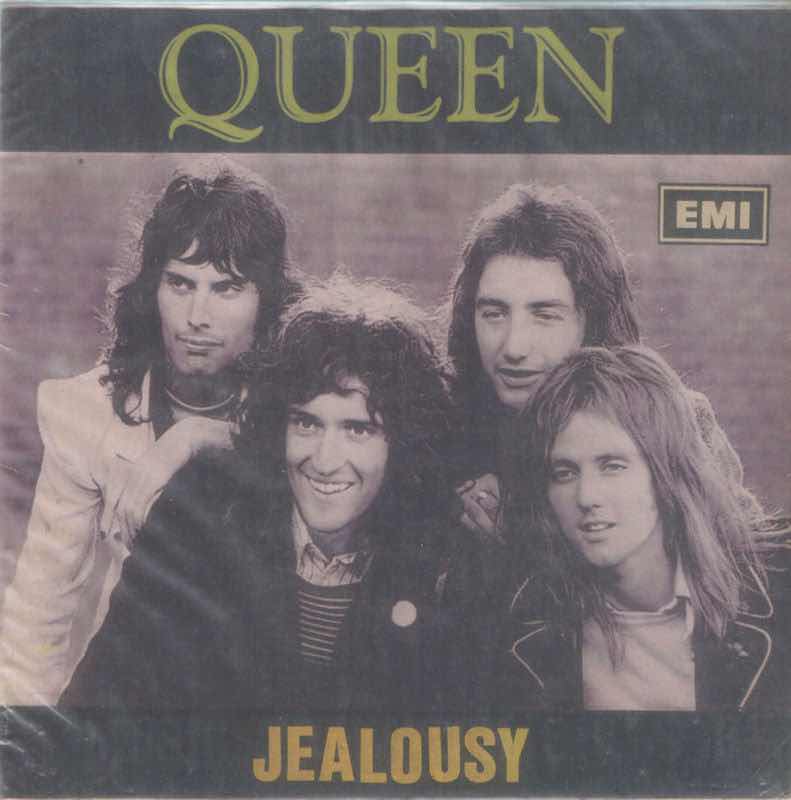
Side A: Jealousy / 3:13
Side B: Fun It / 3:29
US release on Elektra: April 27, 1979 (ref. E-46039)
Best US Chart Ranking: Not Ranked”
From the 1978 Jazz album and written by Freddie Mercury. The song was released in 5 countries including the US but failed to chart.
It’s a piano based song but features the Hallfredh acoustic guitar which is heard on White Queen (As It Began) The guitar had been given a replacement hardwood bridge, chiselled flat, with a small piece of fret wire placed between it and the strings, which lay gently above. The strings produce the "buzzing" effect of a sitar.
Sarm East Studios, London: September 1977 (mixing)
Technical Team
Producers: Queen, Mike Stone
Sound Engineer: Mike Stone
Assistant Sound Engineers: Robert Ash (Basing Street), Gary Lyons (Sarm), Gary Langan (Sarm)
Single
Side A: Spread Your Wings (single edit) / 4:28
Side B: Sheer Heart Attack / 3:24
UK Release on EMI: February 10, 1978 (ref. EMI 2757)
Best UK Chart Ranking: 34”
This was the next John Deacon song after You & I from A Day At The Races album. The band had regretted releasing Tie Your Mother Down over You & I after the single didn’t chart particularly high.
Released on February 10, 1978, “Spread Your Wings” did not chart highly in the United Kingdom, only reaching 34 in the charts. Despite this it’s a fan favourite.
The song tells the story of Sammy who is struggling to make ends meet and being lectured by his boss. Musically it showcases John Deacons songwriting skills. The use of Bm - Bm/A - Bm/G# chords is a skilful touch and you could be forgiven for thinking the track is penned by Freddie Mercury
The song also appears on Queen live album Live Killers
The video was shot in January 1978 by director Rock Flicks in the snowy garden of Roger Taylor’s country house in Surrey while not being able to remember the names of the band. We Will Rock video was also recorded alongside this track
Brian May used the John Birch Red Special copy which would meet its end when Brian got frustrated with the instrument and smashed it.
Sarm East Studios, London: September 1977 (mixing)
Technical Team
Producers: Queen, Mike Stone
Sound Engineer: Mike Stone
Assistant Sound Engineers: Robert Ash (Basing Street), Gary Lyons (Sarm), Gary Langan (Sarm)”
From the first piano chord Fmaj7 the mood is set for quite a sad melancholy song. The song is in fact about Brian Mays childhood cat and discusses the idea of loss and nostalgia.
Songs don’t come with an explanation and this is a great example how the listener will put their own interpretation on a song. Then when you know the subject matter it all makes sense.
Brian May played the piano and sang lead vocals for this track, supported by Freddie Mercury on the backing vocals on the choruses. At 1:44, guitar multi layers come in beautifully.
A completely new version of the song, entitled “All Dead, All Dead” (Original Rough Mix), is on the anniversary edition of the album, which was released in 2017. This version is sung by Freddie Mercury, who added a few lyrics to his introduction.
Personally I prefer the original version with Brian singing, which seems to have a more emotional quality. But it’s still interesting to hear Freddie singing the song.
Freddie Mercury: lead vocals, backing vocals, piano and tack piano, finger snapping
Brian May: electric guitar, backing vocals
John Deacon: bass
Roger Taylor: drums, triangle, tubular bells, backing vocals
Recorded
Wessex Sound Studios, London: early and late August 1974
Trident Studios, London: September 1974 (mixing)
Technical Team
Producers: Queen, Roy Thomas Baker
Sound Engineer: Mike Stone
Assistant Sound Engineers: Geoff Workman (Wessex), Neil Kernon (Trident)
Single
Side A: Killer Queen / 3:00
Side AA: Flick of the Wrist / 3:21
UK Release on EMI: October 11, 1974 (ref. EMI 2229)
US Release on Elektra: October 21, 1974 (ref. E-45226)
Best UK Chart Ranking: 2
Best US Chart Ranking: 12”
“Though “Killer Queen” was one of the last songs recorded for the album in September 1974.
Written by Freddie Mercury the song became the lead single from the Sheer Heart Attack album.
Released on October 11, it shot straight to number two in the UK charts, just behind “Gonna Make You a Star” by David Essex.
Little known fact Killer Queen was double A-side with the song “Flick of the Wrist.”
“Freddie often joked about this, willingly admitting that the song would be perfectly at home in the discography of the late Noel Coward, an actor and pianist famous for his good taste and slightly old-fashioned elegance.
“When Kenny Everett, famous Capital Radio disc jockey, decided to broadcast “Killer Queen” at the end of 1974 said “I’m going to play something on the radio, have a listen to this, it’s the best record that’s ever been made by anybody ever.”
In this video Roger Taylor mentions Kenny loving Killer Queen
A number of people have declared themselves to be the source of inspiration for the song. These include former EMI press attaché Eric Hall, who claimed in Maureen Goldthorpe’s documentary The Story of Queen: Mercury Rising that he kept Moët & Chandon champagne in his office at EMI, and that Freddie himself had told him that he was at the center of his song.”
Production
“During the recording of Killer Queen, Freddie Mercury made two identical piano takes, but with two different instruments: the first with the prestigious studio grand piano, and the second with a piano whose sound was much closer to the honky-tonk models.
Known as a jangle, or tack, piano (detuned piano), this instrument was modified in order to transform its sound.
Thumbtacks were attached to the hammer felts, and with each percussion on the strings, a brilliant sound was produced—a sound quite close to that of the harpsichord.
It is the mix of the two takes that gives the introduction to “Killer Queen” its very particular sound, which we find again later on “Bring Back That Leroy Brown,”